Foreword
For a while, there was an investment trend led by retail investors focusing heavily on US overseas stocks. Now, a new term has become trendy: “Ilhak Ants” (retail investors focusing on Japanese stocks). Unlike the expectations of many, the real estate market prices in major Japanese hub cities are trending upward. Just like stocks, you can invest in the Japanese real estate market via J-REITs. In this post, we will explore what J-REITs are, their advantages, and major REIT products.
1. What is J-REIT Investment?
Japan’s Real Estate Investment Trusts (REITs) are similar to those in the US, with major Japanese corporations participating in the market. As of 2023, there are 41 REIT funds in Japan, forming the largest real estate investment trust fund market in Asia. On a global scale, it ranks second only behind the United States.
In 2000, the Japanese government amended the “Investment Trust Act” into the “Act on Investment Trusts and Investment Corporations,” allowing the funds raised by investment trusts to be used for real estate investments. This established the legal status of real estate investment trusts in Japan.
The major REITs listed on the Tokyo Stock Exchange include:
- Nippon Building Fund (NBF) REIT Inc.
- Japan Real Estate Investment Trust (JRE)
- Nippon Prologis REIT Inc.
- Nomura Real Estate Master Fund REIT
These REITs encompass various sectors including office buildings, retail, logistics, and residential real estate. The performance of these REITs can be tracked on portals such as JAPAN-REIT.COM and J-REIT.jp.
2. What are the advantages of investing in J-REITs?
Investing in Japanese Real Estate Investment Trusts (REITs) presents several benefits:
- Market Accessibility: REITs allow investors to access a diverse portfolio of real estate assets that might be difficult to achieve through direct property ownership.
- Liquidity: Unlike physical real estate, REITs are traded on the stock exchange and can be bought or sold at any time, providing investors with ultimate liquidity.
- Alternative to Property Ownership: REITs offer a way to invest in real estate without the burden of managing the property or paying direct property taxes.
- High Dividend Yield: Generally, REITs offer high dividend yields, which can provide investors with a stable income stream.
- Low Minimum Capital Requirement: Investing in REITs requires relatively low capital input, making them accessible to a broad spectrum of investors.
The fact that there is a strong ally named the Bank of Japan (BOJ) elevates the attractiveness of investing in J-REITs. The BOJ has been increasing its investment scale in listed stocks. Even during the crisis of the COVID-19 pandemic in 2020, they expanded their REIT purchasing scale. Considering the abysmal interest rates of Japanese government bonds, it is highly likely that the BOJ’s scale of investment in listed stocks and REITs will continue to grow.
A characteristic advantage of J-REITs is the system allowing “negative goodwill” to be excluded from distributable profits. For instance, if REIT ‘A’ acquires REIT ‘B’ cheaply—say REIT B is worth 60 billion KRW but is acquired for 50 billion KRW—a negative goodwill of 10 billion KRW is generated. While REITs are generally required to distribute their earnings as dividends, that 10 billion KRW can be retained without being paid out. These resources can then be utilized during crisis situations when paying dividends becomes difficult. Ultimately, this equates to providing considerable stability to REITs.
3. How to invest in J-REITs?
One method is investing in individual REITs. Since REITs are traded on the stock market, just like trading US stocks, investing in J-REITs means investing directly in the Japanese market. The currency used is obviously the Japanese Yen since it is the Japanese market. For stability, one should consider the market’s representative individual REITs as investment targets. If you are not familiar with overseas stock investments, choosing a public mutual fund is another viable option.
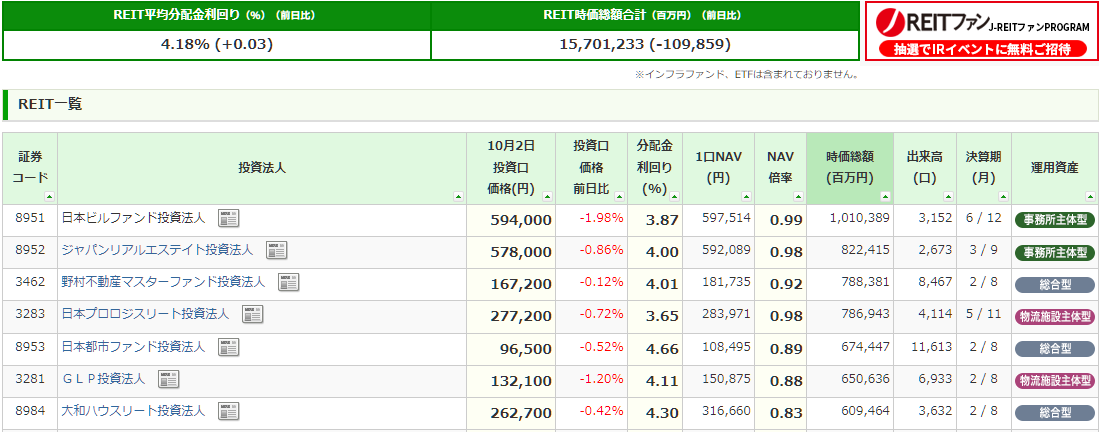
However, personally, since the Yen exchange rate is currently at a historic low, I recommend considering individual REIT investments, keeping future foreign exchange gains in perspective. The representative REITs are listed below. All these REITs track the TSE (Tokyo Stock Exchange) REIT Index. The data below is taken from http://www.japan-reit.com. Although it is in Japanese, the crucial part is the 4-digit code (ticker) at the front, which allows you to check significant information in English on sites like investing.com. Checking key data through that ticker allows you to invest in J-REITs using the same method as trading overseas stocks.
4. Expected Returns and the Tangible Warmth in the Asset Market
While average dividend yields hovered over 4% back in 2023, the explosive surge in prime real estate asset values in central Tokyo has slightly compressed these apparent yields recently. Conversely, this is hard proof that the ‘Capital Gains’ of the underlying assets are rising fiercely.
Currently in 2026, Japan is experiencing a palpable ‘warmth’ sweeping across the entire asset market—spanning not just real estate but extending strongly into the Nikkei stock market. Having completely ripped off the “Lost 30 Years” label and entered a virtuous cycle of rising office rents and domestic recovery, I believe we are standing at the perfect moment to dual-target both stable dividends and remarkable capital gains from commercial J-REITs.
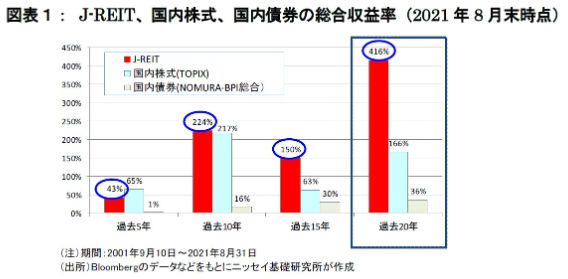
According to research conducted by the Nissei Basic Research Institute, as of late August 2021, the REIT return rate over the past 20 years was 416% (annualized at about 8.6%), which is quite respectable. During the same period, the Japanese stock market, represented by TOPIX, rose by only 166%. This is data proving that the true potential of REITs simply cannot be ignored. Over the past 5 years, the return is 43%. While it is lower than TOPIX over the shorter term, considering the robust stability of dividends, its attractiveness has certainly not diminished.
Those investing in J-REITs can factor in factors like stable dividends of around 3~4%, the possibility of future foreign exchange gains, and capital margins through potential market value increments. Projecting a definitively guaranteed return is impossible for any investment. However, from the standpoint of “stability,” I believe J-REITs are an overseas investment that holds significant advantages.
5. Looking at the Top 3 J-REITs
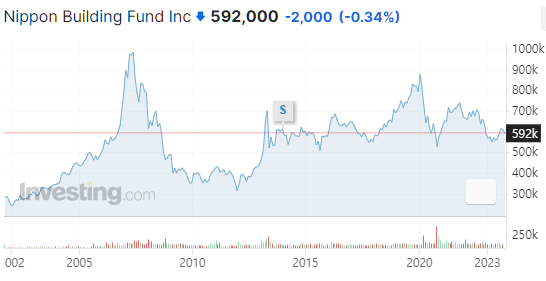
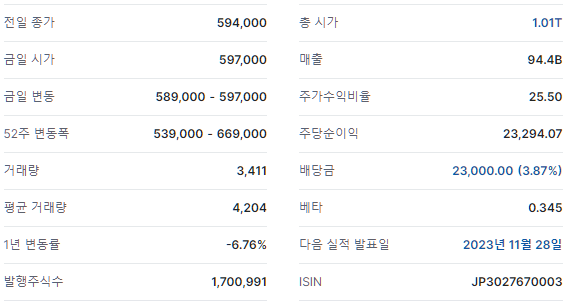
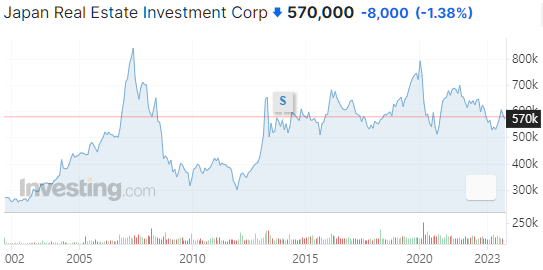
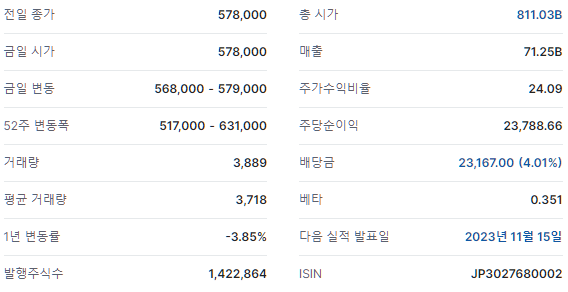
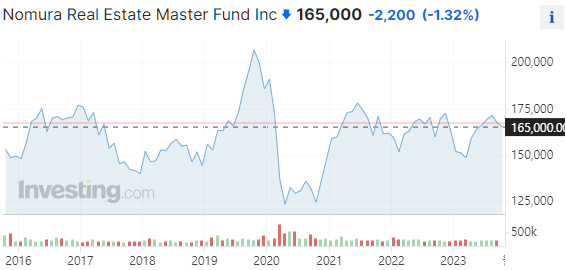
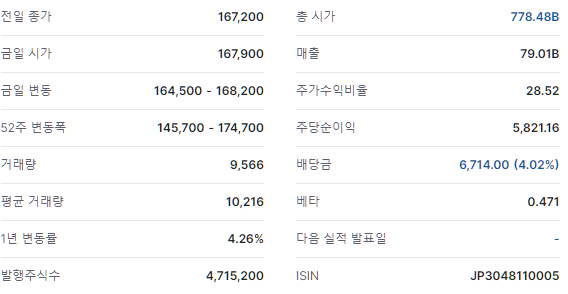
As of the end of September 2023, the total market capitalization of all J-REITs surpassed 15.7 trillion Yen. Even factoring in the weak Yen, it equates to a scale of roughly 140 trillion KRW. Looking at the top 3 REITs by market capitalization, we have the following. You can look up detailed information using the ticker symbols in the parentheses. I’ve compiled simple charts and general info from investing.com below. Please refer to them.
- Nippon Building Fund Inc (8951): A REIT exceeding a market cap of roughly 1 trillion Yen. The dividend yield is 3.87%.
- Japan Real Estate Investment Corp (8952): A REIT exceeding a market cap of roughly 820 billion Yen. The dividend yield is 4.00%.
- Nomura Real Estate Master Fund Inc (3462): A REIT exceeding a market cap of roughly 788 billion Yen. The dividend yield is 4.01%.
- Although its market cap is relatively lower (even so, it’s 670 billion Yen, roughly over 6 trillion KRW), Japan Retail Fund Investment Corp (8953), which boasts a solid dividend yield of about 4.7%, also catches the eye.
Conclusion
“In 2020, while global REITs struggled to pay out dividends, J-REITs actually increased their total dividend distributions compared to the previous year. The shareholder benefit programs of listed Japanese companies are quite exceptional. Due to such benefit programs, quite a few Japanese citizens purchase stocks. It appears that J-REITs serve as an excellent, stable alternative investment channel for the recovering Japanese real estate market. The J-REIT products introduced today primarily hold commercial buildings in urban Japanese city centers as their primary assets. Therefore, buying these REITs is akin to directly investing in commercial buildings in the heart of Tokyo. If you view the future prospects of commercial facilities in central Tokyo—possessing a uniquely different vibe than Seoul—positively, then investing in J-REITs can be a fantastic approach.